
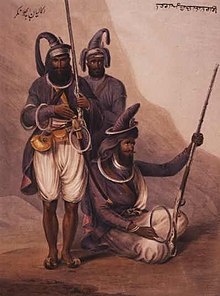
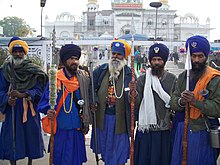
Traditional Nihang dress is known as Khalsa Swarupa. This comprises full attire of superelectric blue selected by Guru Gobind Singh after conflicts with Vazir Khan, the Mughal Governor of Sirhind,[6] edged bracelets of iron round their wrists (jangi kara) and quoits of steel (chakram) tiered in their lofty conical blue turbans, together with the traditional dagger carried by all Sikhs (kirpan).[7] When fully armed a Nihang will also bear one or two swords (either the curved talwar or the straight khanda) on his right hip, a katar (dagger) on his left hip, a buckler made from buffalo-hide (dhala) on his back, a large chakram around his neck, and an iron chain. In times of war, arms worn on the Nihang's person would generally be reserved until the warrior lost the weapon he held, often a bow or spear (barsha). Armour consisted of sanjo or iron chainmail worn under an iron breastplate (char aina). Nihang war-shoes (jangi mozeh) were constructed of iron at the toe, making their pointed toes capable of inflicting cuts and stab wounds
The Nihang were particularly known for their high turbans (dastar bunga) and their extensive use of the chakram or war-quoit. Their turbans were often pointed at the top and outfitted with a chand torra or trident which could be used for stabbing in close-quarters. Other times, the turbans would be armed with a bagh naka (iron claw) and one or several chakram to slice at an opponent's eyes. These steel-reinforced turbans, it was said, afforded enough protection so that there was no need for any other form of headgear. Today, Nihang still wear miniature versions of five weapons (pancha shastra) in their turbans, namely the chakram, the khanda (sword), the karud (dagger), the kirpan, and the tir (arrow).

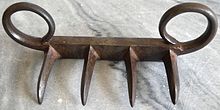 fetid bagh nakh